
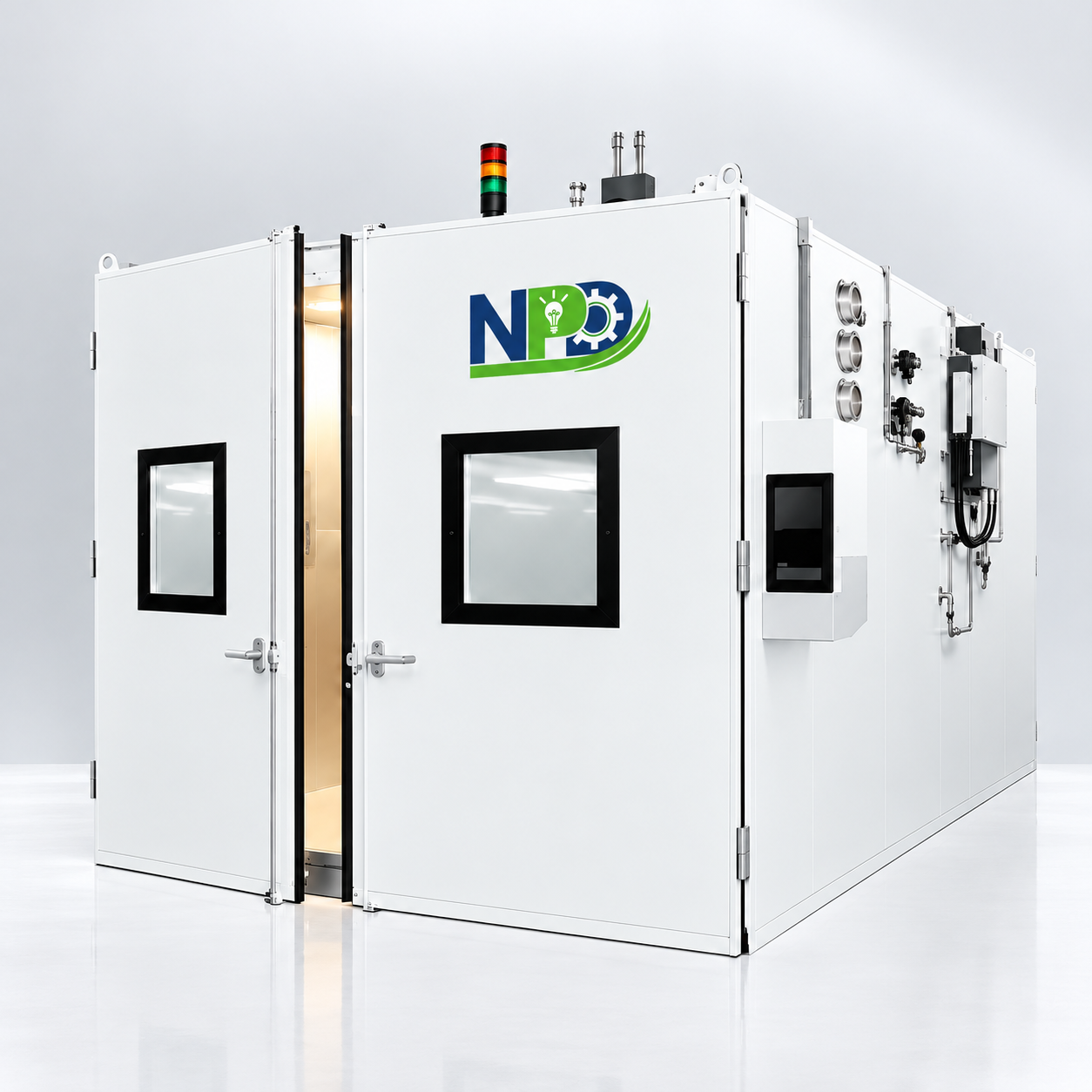
Upload the original product image in WordPress Media Library and replace the image URL in this code.
NPD Battery Test Chamber
The NPD-BTC-218 is a precision-engineered environmental test chamber designed to evaluate safety, performance and reliability of lithium-ion, EV, industrial, nickel-metal hydride and lead-acid batteries. It combines controlled temperature, optional humidity, reinforced construction, digital monitoring and battery-focused safety options for research, production and quality assurance.
Model NPD-BTC-218Heavy Battery PacksProgrammable Control
Optional humidity, LN2 cooling, fire/explosion protection and other safety configurations depend on project requirements.
Advanced Environmental Battery Testing
The NPD Battery Test Chamber reproduces demanding thermal and humidity environments encountered during battery development, transport qualification, cycle-life evaluation and abuse-condition research. The -40°C to +110°C temperature range supports battery thermal cycling profiles, including the temperatures referenced for UN 38.3 Test T2.
Designed for cells, modules, heavy battery packs and battery-management systems, the chamber helps assess thermal behaviour, capacity retention, electrical performance, sealing integrity and safety response. Reinforced flooring and sliding SS 304 trays support sample handling.
Key Features & Benefits
Controlled performance testing with battery-focused safety engineering.
Precise Temperature Control
Operating range from -40°C to +110°C, with temperature stability below ±1.0°C and uniformity below ±2°C.
Optional Humidity Testing
Humidity configuration from 30% to 98% RH with stated ±3% RH fluctuation around the set point.
Non-Sparking Components
Externally mounted lighting and non-sparking fan blades and blower wheels help reduce potential ignition sources.
Reinforced Chamber
Heavy-duty chamber floor and SS 304 sliding platforms are designed for battery samples and thermal loads.
Door Safety & Monitoring
Open-door sensor with automatic shutdown, screen alerts, insulated door and 700 × 700 mm heated viewing window.
Advanced Safety Options
Optional protective structure, fire-suppression interface and LN2 test-article surface cooling for specialised testing.
Technical Specifications
Model NPD-BTC-218 — based on the supplied product document.
| Parameter | Specification |
|---|---|
| Make | NPD |
| Model No. | NPD-BTC-218 |
| Temperature Range | -40°C to +110°C |
| Temperature Stability | Below ±1.0°C |
| Temperature Uniformity | Below ±2°C |
| Relative Humidity Range (Optional) | 30% to 98% RH ±3% RH |
| Humidity Accuracy (Optional) | Set-point fluctuation ±3% RH |
| Inner Chamber Material | SS 304 stainless steel |
| Outer Chamber Material | Galvanised steel with powder-coated finish |
| Inner Dimensions (W × D × H) | 750 × 900 × 1,200 mm (2.5 × 3 × 4 ft) |
| Sample Weight | 7 kg to 100 kg |
| Door | Insulated, powder-coated galvanised sheet door |
| Viewing Window | 700 × 700 mm, with condensation-free heaters |
| Door Safety | Open-door sensor, automatic chamber shutdown and screen alert |
| Door Sealing | Silicone gasket |
| Trays | SS 304 sliding platform trays |
| Power Supply | 415 V AC ±10%, three-phase with neutral, 50 Hz |
| Insulation | High-efficiency insulation for stable temperature control and energy savings |
Specifications are based on the supplied NPD-BTC-218 configuration and may be customised for battery formats, safety levels and test protocols.
Designed with Battery-Focused Safety Features
The NPD-BTC-218 provides reinforced construction, externally mounted lighting and non-sparking air circulation components to help minimise ignition hazards during tests of energy-dense cells and packs. Optional protective enclosure structures are designed to address abnormal events such as fire or explosion.
Optional liquid-nitrogen (LN2) cooling can be configured to cool the test article's surface in overheating scenarios. These features contribute to a broader safety strategy but do not eliminate thermal-runaway risk; final safety measures must be evaluated against the intended battery type, test protocol and risk assessment.
How the Battery Test Chamber Works
Controlled environmental testing from sample loading to results evaluation.
Sample Loading
Load the battery cell, module or pack using the appropriate SS 304 sliding platform and safety setup.
Profile Programming
Program temperature and, where configured, humidity, alarms and test-sequence parameters.
Environmental Exposure
Expose the test sample to the required controlled environmental profile while monitoring operation.
Review & Logging
Evaluate test behaviour and review available alerts, profile states and logged data.
Programmable Control and Monitoring
The digital control platform provides 8 configurable digital inputs for start, stop, pause and other profile interactions. Its “wait for” feature can hold a profile step until a selected input changes state, helping coordinate testing with battery cyclers and external safety systems.
It also provides 15 programmable customer-event outputs for alarms, profile status, ventilation control, fire-suppression interfacing and other configured actions. Optional packages include refrigeration monitoring and logging, automated dew-point management and barcode-driven profile initiation and data annotation.
Battery Testing Standards Support
The supplied document describes support for qualification programmes including UN 38.3 (including Test T2 thermal cycling), IEC 62133 / IS 16046, and application-specific EV, aerospace, defence and energy-storage protocols. Support for a test method does not itself establish product certification or compliance; the complete testing setup and required procedures must be validated for the applicable standard.
Applications & Industries
Battery evaluation, safety research and environmental qualification.
Battery Test Chamber FAQs
What temperature range does the NPD-BTC-218 offer?
The chamber's specified temperature range is -40°C to +110°C, with stability below ±1.0°C and uniformity below ±2°C.
Does the chamber support humidity testing?
Humidity is an optional configuration with a stated range of 30% to 98% RH and ±3% RH set-point fluctuation.
What are the inner dimensions?
The specified inner dimensions (W × D × H) are 750 × 900 × 1,200 mm.
What battery safety features are available?
Features include door-open detection, automatic shutdown and screen alert, reinforced construction, externally mounted lights and non-sparking circulation components. Protective structures and LN2 surface cooling are available as options.
Can the chamber support UN 38.3 testing?
The product document describes support for battery transport and environmental testing programmes, including UN 38.3 Test T2 thermal cycling. Formal compliance depends on the actual test method, complete equipment configuration, validation and test results.
Can the chamber integrate with external battery cyclers?
Yes. The documented configurable digital inputs, programmable outputs and profile waiting function are designed to support integration with external testing or safety equipment.
Need a Battery Test Chamber for Your Facility?
Share your battery format, sample weight, environmental conditions and safety requirements with our team to discuss an NPD-BTC-218 configuration and quotation.