
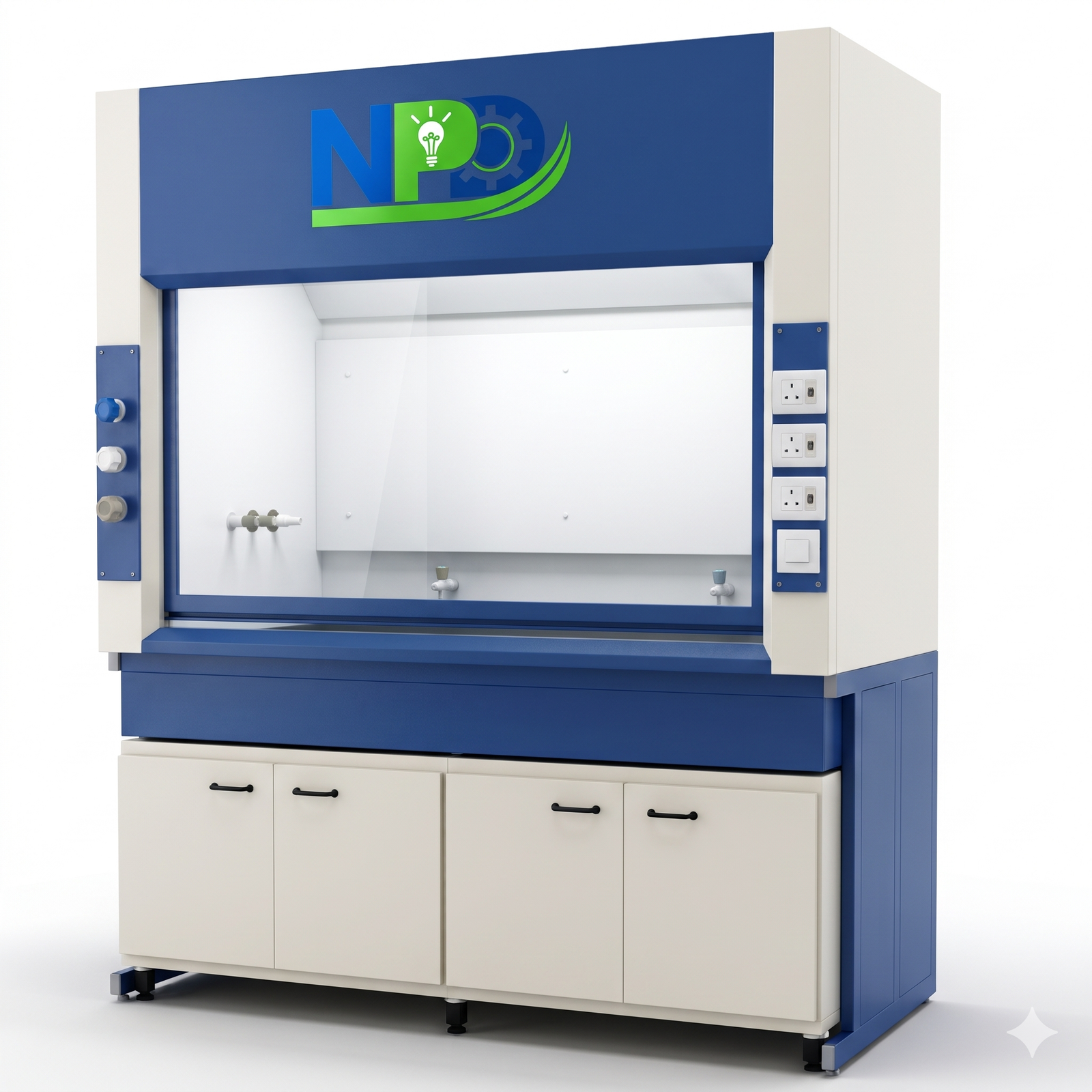
NPD Modular Fume Hood
The NPD-236 Modular Fume Hood is a floor-mounted, chemical-resistant laboratory enclosure designed for handling acids, alkalis, solvents, reagents and other hazardous chemicals. Its low constant-volume exhaust, three-point suction system, chemical-resistant inner lining and integral base storage cabinet support general chemical fume-handling work in research, quality-control and industrial laboratories.
1,200 mm1,500 mm1,800 mm2,100 mm
Final face velocity, ducting, blower and exhaust-treatment arrangements should be confirmed for the selected model and installation site.
Reliable Fume Extraction for Chemical Laboratories
The NPD-236 uses a three-point suction arrangement with a removable rear baffle and horizontal slots to draw fumes from different levels within the enclosure. An aerodynamic airfoil at the worktop edge helps direct airflow and supports spill retention. A tapered, flanged exhaust collar is designed to reduce turbulence and assist stable airflow through the connected exhaust system.
The floor-mounted, double-skinned body has a chemical-resistant epoxy powder-coated outer finish and a 6 mm PRL inner lining. The work area includes a dished cored granite worktop, PP or porcelain cup sink, utility services, vapour-proof lighting and an integral chemical-storage cabinet.
Key Features & Benefits
Purpose-built construction, airflow management and practical laboratory utilities.
Three-Point Suction
Rear baffle with lower, middle and upper horizontal slots helps remove light, normal and heavy fume loads.
Chemical-Resistant Inner Liner
6 mm PRL lining provides a smooth, cleanable surface with chemical and heat resistance and fire-retardant properties.
Dished Granite Worktop
Cored granite worktop with reinforced marine edges and chemical-resistant side skirting helps contain spills.
Counterbalanced Glass Sash
Vertical-rising sash made from 4 mm toughened float glass with a 700 mm clear opening height.
Laboratory Utility Services
Water, compressed air, nitrogen and vacuum utility points with brass fittings rated up to 200 psi.
Integrated Base Cabinet
Rigid steel base cabinet with double-skin shutters, adjustable shelf, removable partition and locking arrangement.
Technical Specifications
NPD-236 Modular Fume Hood — specification based on the supplied product document.
| Parameter | Specification |
|---|---|
| Make | NPD Eco Technologies |
| Model | NPD-236 Modular Fume Hood |
| Application | General chemical fume section |
| Structure | Aerodynamic, floor-mounted, double-skinned construction |
| Outer Body | CRC sheet with chemical-resistant epoxy powder coating |
| Inner Liner | 6 mm thick PRL; chemical-resistant, heat-resistant and fire-retardant |
| Worktop | Thick dished cored granite with marine edges and chemical-resistant skirting |
| Cup Sink | PP / porcelain |
| Rear Baffle | Removable baffle with three-point suction and horizontal slots |
| Airfoil | Fixed aerodynamic horizontal airfoil at the worktop edge |
| Sash | Vertical-rising, counterbalanced, 4 mm toughened float glass |
| Clear Sash Opening | 700 mm |
| Lighting | 2 × 40 W vapour-proof fluorescent lamps; approximately 400 lux at worktop |
| Utility Valves | 1 water, 1 compressed air, 1 nitrogen and 1 vacuum; brass fittings up to 200 psi |
| Electrical Utilities | 2 × 15 A switched sockets; 1 MCB for blower |
| Exhaust System | Low constant-volume exhaust |
| Blower | SISW centrifugal blower; chemical- and heat-resistant, epoxy-coated housing, dynamically balanced impeller and drain plug |
| Motor | Heavy-duty 3-phase TEFC, IP55, Class F, continuous rating |
| Face Velocity | 80–100 fpm; minimum 0.5 m/s / 100 fpm at the defined sash position, as specified in the source document |
| Noise Level | Less than 60 dB with remote-mounted blower |
| Airflow Monitor | Approximate face-velocity indicator with low-flow audible alarm and green/red LED indication |
| Base Cabinet | Rigid steel structure, epoxy powder-coated, double-skin shutters, adjustable shelf and locking system |
| Levelling | Adjustable levelling feet |
| Fire Safety | 1 portable fire extinguisher |
| Ducting | Optional rigid PVC ducting with bends, dampers, transitions and clamps |
The source document lists face-velocity wording as both 80–100 fpm and a minimum 0.5 m/s / 100 fpm at the defined sash position. Confirm the required design setpoint and test method during quotation and commissioning.
Available Modular Fume Hood Models
External and internal dimensions (W × D × H).
| Model | External Dimensions (mm) | Internal Dimensions (mm) |
|---|---|---|
| NPD-3 (PRO) | 1,200 × 850 × 2,300 | 950 × 750 × 1,200 |
| NPD-4 (PRO) | 1,500 × 850 × 2,300 | 1,250 × 750 × 1,200 |
| NPD-5 (PRO) | 1,800 × 850 × 2,300 | 1,550 × 750 × 1,200 |
| NPD-6 (PRO) | 2,100 × 850 × 2,300 | 1,850 × 750 × 1,200 |
How the Fume Hood Works
Airflow capture and extraction help manage fumes generated during laboratory work.
Air Enters the Hood
Room air moves through the front sash opening toward the work area under the action of the exhaust system.
Airfoil Directs Flow
The horizontal airfoil helps guide airflow across the worktop and supports spill retention at the front edge.
Three-Point Capture
Lower, middle and upper slots in the rear baffle draw fumes according to their generation pattern and density.
Exhaust Through Ducting
The blower conveys extracted air through the exhaust duct; appropriate duct material and treatment depend on the chemicals handled.
Designed for Fume Capture
The removable rear baffle distributes airflow across the hood interior. Three-point suction is intended to capture fumes from lower, middle and upper regions, while the tapered and flanged exhaust collar helps reduce turbulence and noise. The blower and connected ducting must be selected to provide the required airflow and static pressure.
After installation, commissioning should verify average face velocity, velocity uniformity, containment performance at the designated sash height and correct operation of the low-flow alarm.
Practical Laboratory Features
The hood includes two 40 W vapour-proof fluorescent lamps providing approximately 400 lux at the worktop. Utility service points are specified for water, compressed air, nitrogen and vacuum using brass fittings rated up to 200 psi. The electrical configuration lists two switched 15 A sockets and one MCB for the blower.
Utility configurations, electrical requirements and exhaust arrangements should be checked against the actual installation and customer requirements before ordering.
Applications & Industries
For laboratory operations involving chemical fumes and vapours.
Optional Accessories & Site Requirements
Optional Accessories
- Rigid PVC ducting supplied per running foot, with bends, dampers, transitions and clamps
- Remote-controlled utility valves with panel-mounted DIN heavy-duty cast-brass fittings
- Epoxy scaffold / lattice for apparatus support
- Optional PP blower assembly with heavy-duty PP housing and PP blower
- Scrubber mounted above the system for exhaust-gas treatment where required
- Airflow monitor and low-flow alarm
- Portable fire extinguisher
Customer Scope & Installation
- Civil work, plumbing, block foundation and laboratory painting
- Utility and electrical connections up to the fume hood
- Mounting of the remote blower kit and provision of a blower foundation or platform
- Adequate clear false-ceiling height for the hood and exhaust ducting
- Level, load-bearing floor capable of supporting the hood, cabinet and stored materials
- Appropriately sized exhaust duct and blower system
- Chemical-resistant ducting and exhaust treatment where required
Installation should include airflow and face-velocity checks, containment verification, alarm testing and periodic preventive maintenance of the blower, sash, baffles and airflow monitor.
Modular Fume Hood FAQs
What is the NPD-236 Modular Fume Hood used for?
It is designed for general chemical fume handling, including acid, alkali, solvent and reagent handling, sample digestion, titration and wet-chemical analysis in laboratory environments.
What face velocity is specified?
The supplied document lists 80–100 fpm and also states a minimum 0.5 m/s / 100 fpm at the defined sash position. Confirm the final setpoint and test requirements for the selected configuration.
What type of suction system does it use?
The hood uses a three-point suction system with lower, middle and upper horizontal slots in the rear baffle, designed to capture fumes from different regions of the enclosure.
What are the available model sizes?
NPD-3 (PRO): 1,200 × 850 × 2,300 mm external; NPD-4 (PRO): 1,500 × 850 × 2,300 mm; NPD-5 (PRO): 1,800 × 850 × 2,300 mm; NPD-6 (PRO): 2,100 × 850 × 2,300 mm. Internal dimensions are listed in the model table above.
Which utility services are included?
The document specifies one each for water, compressed air, nitrogen and vacuum, with brass fittings rated up to 200 psi. Confirm the final utility configuration when ordering.
Is ducting included?
Rigid PVC ducting is listed as optional and may include bends, dampers, transitions and clamps. Ducting length, diameter, routing and blower requirements should be confirmed for the installation site.
Can a scrubber or PP blower be supplied?
Yes. The supplied document lists a PP blower assembly and a scrubber for exhaust-gas treatment as optional accessories where required.
What should be checked after installation?
Verify airflow, average face velocity, velocity uniformity, containment performance at the specified sash height and alarm operation. Periodic testing and preventive maintenance are also recommended in the source document.
Need a Modular Fume Hood?
Share your preferred model size, worktop, blower type, utilities, ducting and scrubber requirements to request configuration details and pricing.