
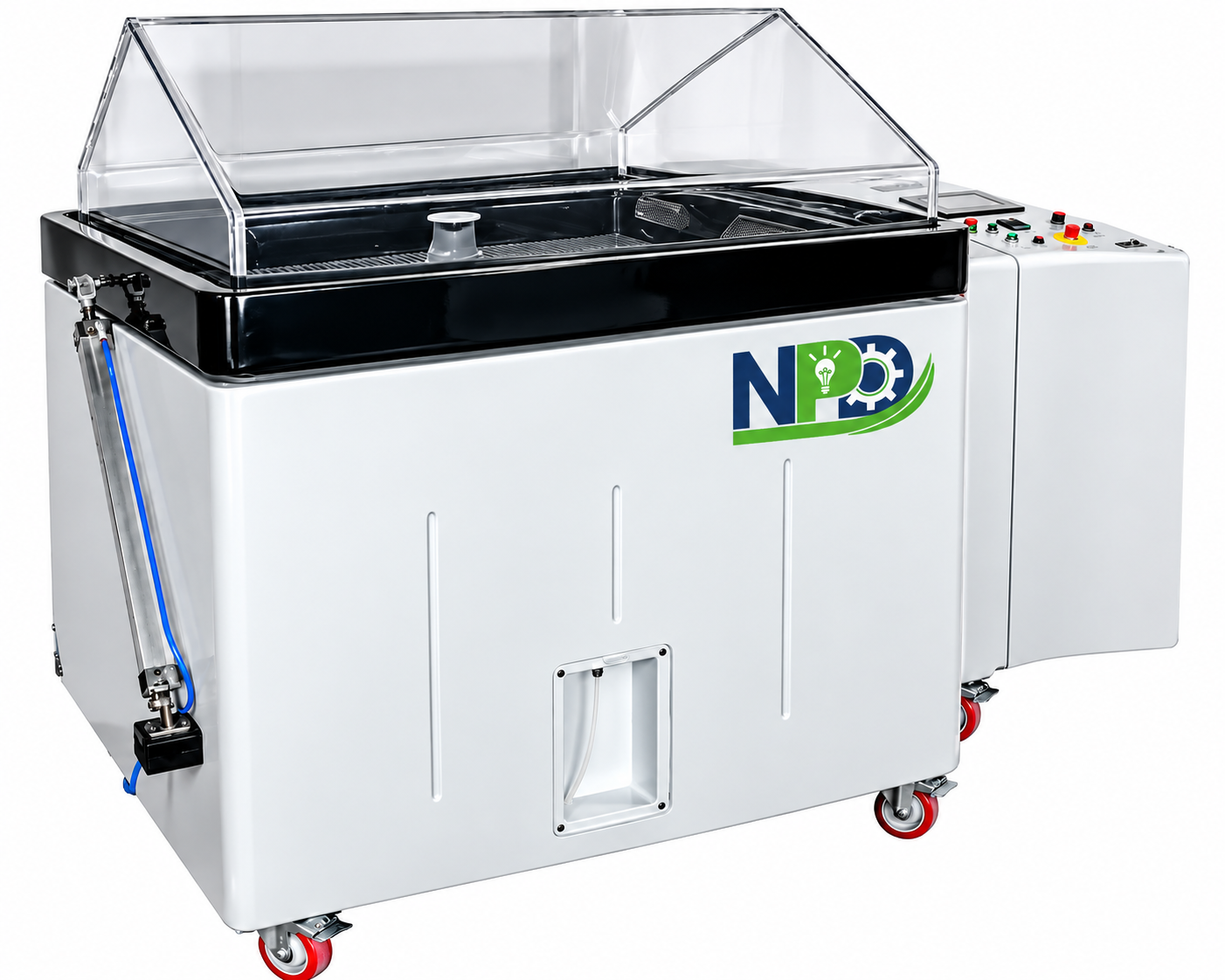
NPD Salt Spray Chamber
Model: NPD-248 | Precision Corrosion & Salt Fog Testing System
NPD Salt Spray Chambers simulate chloride-rich environments using finely atomised salt fog to evaluate coating durability, corrosion resistance and protective finish performance. Engineered for automotive, marine, aerospace, defence, electronics and quality-control laboratories.
Custom sizes, spray configurations and accessories available on request.
Reliable Corrosion Resistance Testing
The NPD Salt Spray Chamber creates a carefully controlled salt-fog atmosphere to assess how coatings, metals, fasteners and assemblies withstand corrosive environments. Accurate solution atomisation, regulated temperatures, and programmable testing improve consistency and repeatability across inspections.
Designed to support neutral salt spray test protocols such as ASTM B117 and ISO 9227, these chambers can be configured for different chamber capacities, test durations and industrial requirements.
Key Features & Benefits
Purpose-built controls for reproducible salt-fog exposure.
Uniform Salt Fog
Precision atomising nozzle and optimised air circulation distribute mist evenly through the test space.
Programmable Test Cycles
Independently configure spray interval, dwell cycle and total exposure duration.
Precise Environment Control
Control chamber and saturator temperatures using PLC/HMI or microprocessor-based controls.
Corrosion-Resistant Body
Industrial FRP, PVC and PP construction options support long-term salt-fog exposure.
Integrated Safety Protection
Low-water-level, over-temperature and air-pressure protection with fault alarms.
Configurable Test Capacity
Choose between 250 and 2,000 litre models, with custom capacities and accessories available.
Technical Specifications
Parameter details from the supplied NPD Salt Spray Chamber PDF.
| Parameter | Specification |
|---|---|
| Supported methods | ASTM B117 / ISO 9227; JIS and other protocols by configuration |
| Chamber temperature range | 35°C to 50°C |
| Humidity range (model table) | 95% ±5% RH |
| Salt solution | 5% NaCl |
| Spray rate (model table) | 1–2 mL/hour per 100 cm² (as shown in supplied model table) |
| Reference NSS fog collection | 1.0–2.0 mL/hour per 80 cm² at 35°C ±2°C (supplied standards section) |
| Control system | PLC touchscreen or microcontroller display, depending on model |
| Interior / construction | Corrosion-resistant FRP, PVC, PP and compatible industrial-grade materials |
| Spray system | Precision atomising nozzle and optimised chamber circulation |
| Safety | Low water level, over-temperature, regulated air pressure and automatic fault alarms |
| Customisation | Chamber capacity, spray configurations, cycle programming and accessories |
Note: The supplied PDF states different fog-collection area bases: the model table says 1–2 mL/hour per 100 cm², while the standards reference says 1–2 mL/hour per 80 cm². Confirm the correct model-specific rate before publication or quotation.
Available Models
Five configurations across laboratory and production testing needs.
| Model | Capacity | Temperature | Salt Solution | Controller | Power Supply |
|---|---|---|---|---|---|
| NPD SPC-3 | 250 L | 35–50°C | 5% NaCl | PLC Touchscreen | 220 V, 50 Hz |
| NPD SPC-4 | 400 L | 35–50°C | 5% NaCl | PLC Touchscreen | 220 V, 50 Hz |
| NPD SPC-5 | 500 L | 35–50°C | 5% NaCl | PLC Touchscreen | 220 V, 50 Hz |
| NPD SPC-10 | 1,000 L | 35–50°C | 5% NaCl | Microcontroller Display | 220 V, 50 Hz |
| NPD SPC-20 | 2,000 L | 35–50°C | 5% NaCl | PLC Touchscreen | 380 V, 50 Hz |
All five model entries in the source list ASTM B117 / ISO 9227, 95% ±5% RH and 1–2 mL/hour per 100 cm²; reference NSS collection conditions elsewhere in the document use 80 cm².
How Salt Spray Testing Works
Controlled exposure, consistent procedures and measurable outcomes.
Prepare samples
Position coated panels, components or assemblies within the test chamber as required by the chosen method.
Prepare solution
Fill the system with the specified salt solution and set chamber and saturator temperatures.
Generate salt fog
The atomising nozzle disperses a controlled salt mist while the controller manages exposure and spray cycles.
Evaluate resistance
At defined intervals, assess rusting, blistering, coating damage and other corrosion outcomes.
Standards & Reference Conditions
Neutral salt spray test conditions stated in the supplied document.
Suitability for a specific standard depends on equipment configuration, calibration and actual test setup. These are source-listed support claims, not independent certification.
Programmable Control and Durable Design
The system uses a PLC/HMI touchscreen or PID microprocessor-based controller, depending on the model. Test operators can set chamber temperature, saturator temperature, spray interval, spray duration and total testing time. Configurable alarms help keep conditions within operational limits.
Corrosion-resistant FRP, PVC, PP and compatible components are used in the chamber construction. The integrated protection suite includes low-water-level and over-temperature safeguards, pressure regulation and automatic fault alarms, supporting reliable long-duration testing.
Where Salt Spray Chambers Are Used
Evaluate finishes, assemblies and products exposed to corrosive environments.
Salt Spray Chamber FAQs
What is a salt spray test chamber used for?
It exposes samples to a controlled salt fog to evaluate corrosion resistance of coatings, metals, plated parts and finished assemblies.
What capacities are available?
The supplied model range covers 250 L, 400 L, 500 L, 1,000 L and 2,000 L, with custom capacities available upon request.
Which corrosion test standards can it support?
The PDF identifies ASTM B117 and ISO 9227 neutral salt spray testing, as well as JIS and equivalent test methods depending on configuration.
What salt solution is used for neutral salt spray testing?
The PDF lists 5% sodium chloride solution for NSS testing. The precise operating parameters should follow the selected method.
Can spray cycles and temperatures be programmed?
Yes. Controllers allow chamber and saturator temperature settings plus spray interval, spray duration and total test time.
Are installation and maintenance services available?
The supplied NPD document states that technical support, installation assistance, calibration and after-sales services are provided.
Need a Salt Spray Test Chamber?
Share your test method, specimen size, required chamber capacity and operating conditions for the right model and a customised quotation.